





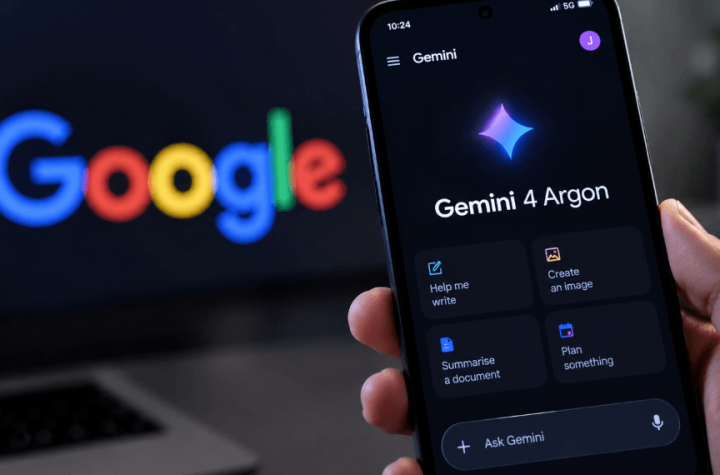
Google has begun rolling out Gemini 4 Argon, its latest artificial intelligence model, to paying subscribers through the Gemini app. The update promises improved reasoning, greater mathematical accuracy and more concise responses, as the technology company seeks to make its AI assistant more useful for everyday tasks.
The release follows Google’s announcement of Gemini 4 Argon in late September 2026. The new model succeeds Gemini 3.5 Pro and Gemini 3.8 Flash, introducing improvements designed to handle complex requests while reducing unnecessary repetition and overly lengthy answers.
Gemini 4 Argon Now Available to Google AI Pro and Ultra Subscribers
Google confirmed on 13 October 2026 that Gemini 4 Argon had started rolling out to customers subscribed to its Google AI Pro and Google AI Ultra plans.
The company announced the availability through its official account on X, explaining that eligible subscribers would gradually gain access to the model within the existing Gemini application.
Users will not need to install a separate application to access the new technology. Instead, Gemini 4 Argon will appear as an additional model option once the update becomes available to their accounts.
However, access is currently restricted to Google’s higher-tier subscription plans.
Free and Google AI Plus Users Must Wait
Gemini 4 Argon is not yet available to users on the free Gemini service or the lower-priced Google AI Plus subscription.
Google has not confirmed when these customers might receive access, although a wider release remains possible.
The rollout is also taking place gradually, meaning some eligible subscribers may not immediately see the new model.
Users are advised to ensure their Gemini application is updated, although availability ultimately depends on Google’s account-level rollout.
Google Aims to Reduce Repetitive and Unnecessarily Long AI Answers
One of the most significant changes introduced with Gemini 4 Argon concerns how the chatbot communicates with users.
Google says the new model has been designed to provide clearer, more direct answers while avoiding unnecessary qualifications, repeated explanations and familiar AI-generated phrases.
Previous generations of conversational AI have frequently been criticised for producing lengthy responses to relatively straightforward questions.
Gemini 4 Argon aims to address that issue by prioritising relevant information and presenting answers more efficiently.
Improved Tone, Formatting and Instruction Following
Google also claims that Gemini 4 Argon follows writing and formatting instructions more consistently than earlier versions.
This could benefit users who rely on AI tools for professional correspondence, document preparation, research summaries and other written tasks.
For example, someone requesting a short business email or a concise explanation should receive an answer that more closely follows the specified length, tone and structure.
The changes may prove particularly useful for UK businesses, students and professionals increasingly incorporating generative AI into routine workflows.
However, the extent of these improvements will become clearer as more subscribers begin using the model.
Stronger Reasoning, Mathematical Accuracy and Visual Coding
Beyond conversational improvements, Google says Gemini 4 Argon delivers advances across several technical capabilities.
These include spatial reasoning, mathematical precision and visual coding, alongside improved performance when completing complex, multi-stage tasks.
Spatial reasoning allows AI systems to interpret relationships between objects, positions and visual information.
Improved mathematical capabilities could support more demanding calculations and analytical work, while advances in visual coding may assist developers working with interfaces and other visually structured applications.
Better Progress Updates for Complex Tasks
Google has also focused on improving how Gemini communicates during longer operations.
According to the company, Gemini 4 Argon provides more frequent and useful progress updates while processing complicated requests.
This is intended to give users greater visibility into ongoing work rather than leaving them waiting without an indication of what the system is doing.
The improvement could be relevant to people using AI for research, software development, document analysis and other activities involving multiple stages.
Gemini 4 Argon Introduces One-Million-Token Output Capacity
Another feature highlighted by Google is the model’s claimed output capacity of one million tokens.
Tokens are the units AI systems use to process and generate language, with individual words sometimes consisting of multiple tokens.
A larger output capacity could allow Gemini 4 Argon to produce substantially longer and more detailed material when required.
This creates an important distinction in Google’s approach: the model is intended to deliver shorter answers for straightforward questions while retaining the ability to generate extensive responses for demanding tasks.
Such flexibility could support technical documentation, lengthy reports and complex content-generation projects.
Gradual Rollout Means Some Subscribers May Still Be Waiting
Despite the official launch, Gemini 4 Argon is not appearing immediately for every eligible subscriber.
Early reports indicate that some Google AI Pro customers have yet to receive access, suggesting the company is enabling the model progressively.
Subscribers who cannot currently find Gemini 4 Argon in their model selection menu may therefore need to wait for the rollout to reach their accounts.
For Google, the launch represents another step towards making Gemini more capable without sacrificing clarity or ease of use. Whether its promises of sharper reasoning and less repetitive language translate into a noticeably better experience will depend on how the model performs as availability expands.

Graham Greene is a contributor to Dealmakerz, covering news, politics, business, technology, sport, entertainment, and lifestyle. He focuses on clear, accurate reporting and useful information that helps readers stay informed about current affairs and developments that matter to them. His work highlights relevant stories, emerging trends, and key issues, presenting them in a balanced, accessible, and reader-friendly way.



More Stories
Microsoft Urges Entra ID Admins to Move Users to Passkeys Before SMS Sign-In Retirement
Polish Developer Builds App That Detects Nearby Meta Smart Glasses
Google Pics Launches with AI Image Creation and Editing Across Docs, Slides and Drive