





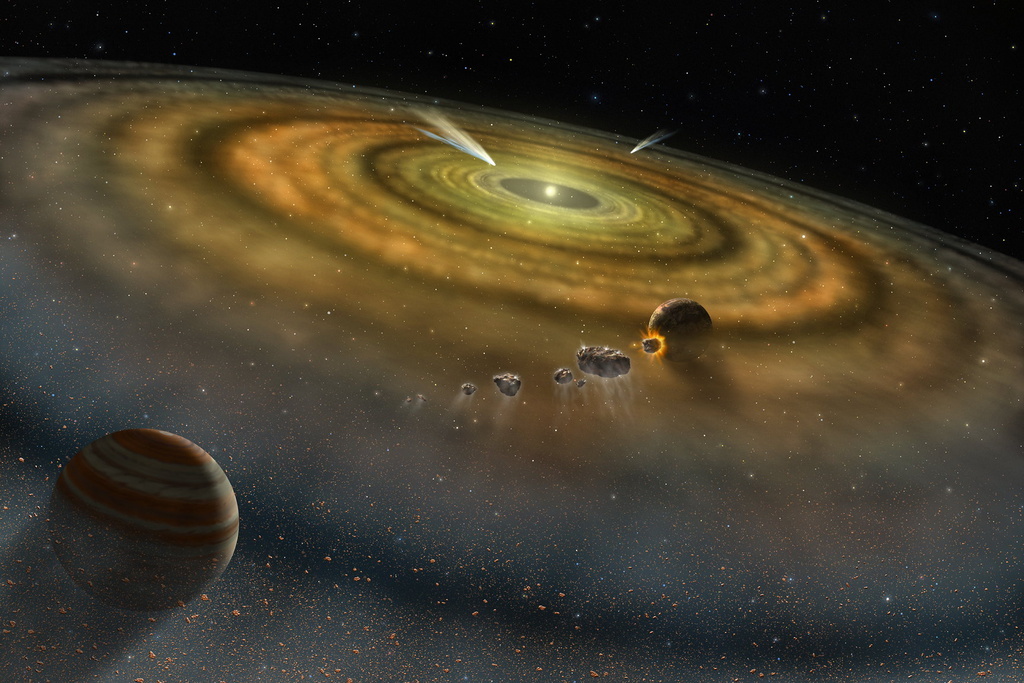
The theory that the Earth was made of pebbles is strengthened and developed in a new study. Cosmic dust also played a major role in planet formation.
Last year, a research group at Lund University theorized that millimeter-sized stones had been sucked together for millions of years and had grown to the current size of our celestial bodies.
This pebbles theory conflicts with the idea that the Earth was formed from multiple collisions of giant asteroids.
Now professor of astronomy Anders Johansen, in collaboration with researchers in Denmark and China, returns with new findings published in the scientific journal Science Advances.
“Through advanced computer simulations, we can demonstrate that Earth was formed from a mixture of pebbles and dust from supernova explosions in the outer solar system, as well as dust from the inner solar system that contains much less dust than supernovae,” says Anders Johansen in Press release from Lund University’s Faculty of Science.
Anders Johansen, Professor of Astronomy at Lund University. Photo gallery. Photo: Johann Joelson
According to the explanatory models previously defended, giant Jupiter’s gravitational field prevented supernova-rich dust particles from finding their way into the central parts of the solar system. The new study now shows, according to Anders Johansen, that Jupiter did not play as large a role in the formation of the solar system as previously thought.

Graham Greene is a contributor to Dealmakerz, covering news, politics, business, technology, sport, entertainment, and lifestyle. He focuses on clear, accurate reporting and useful information that helps readers stay informed about current affairs and developments that matter to them. His work highlights relevant stories, emerging trends, and key issues, presenting them in a balanced, accessible, and reader-friendly way.




More Stories
Google Rolls Out Gemini 4 Argon With Smarter Reasoning and Less Wordy AI Responses
Microsoft Urges Entra ID Admins to Move Users to Passkeys Before SMS Sign-In Retirement
Polish Developer Builds App That Detects Nearby Meta Smart Glasses