





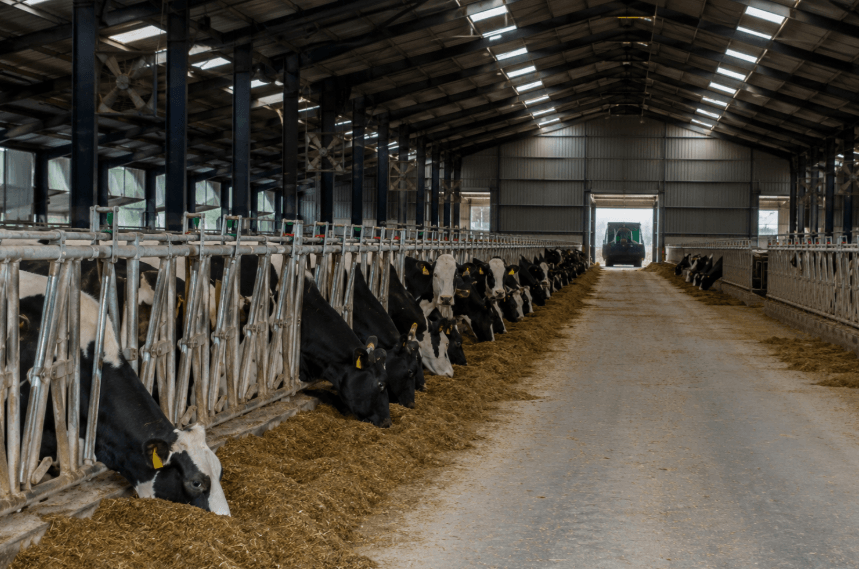
Factory-style dairy farming is expanding rapidly across the UK, with growing numbers of farms keeping cows indoors year-round as financial pressures mount across the agricultural sector. An investigation has found that the number of intensive dairy units has more than doubled over the past decade, prompting renewed debate over animal welfare, environmental standards and the future of British farming.
Number of Intensive Dairy Farms Has More Than Doubled
According to an investigation by the Bureau of Investigative Journalism (BIJ), there are now at least 180 dairy farms across the UK where some cows are permanently housed indoors without access to grazing fields. In 2015, that figure stood at around 70.
The number of so-called “mega dairies” — farms with more than 700 cows — has also doubled during the same period. There are now around 40 such sites operating across Britain, with the largest housing up to 2,600 cattle.
Unlike intensive pig and poultry farms, large dairy operations are not currently required to hold environmental permits, meaning there is no official public register detailing how many exist or where they are located.
Financial Pressures Driving Expansion
The shift towards larger, more intensive systems comes as dairy farmers face mounting financial strain. Rising costs for fertiliser, fuel and animal feed have significantly increased production expenses, while milk prices paid to farmers have often failed to keep pace.
Some producers reported selling milk for as little as 28p per litre despite production costs reaching roughly 40p per litre.
One farmer involved in the investigation said many operators felt forced to expand in order to survive financially.
“They feel like they’ve got to do it,” the farmer said anonymously.
Major Dairy Regions Becoming Hotspots
Using public records, satellite imagery and drone footage, investigators identified 42 large-scale dairy units across the UK. Counties including Devon, Cornwall, Dorset and Cheshire emerged as key centres for intensive dairy production.
Of those 42 mega dairies, 16 were found to house more than 1,000 cows each. Some of the largest operations were located in Pembrokeshire, Lancashire and Cheshire.
For comparison, the average dairy herd in the UK contains around 160 cows.
Several intensive units have reportedly supplied major dairy processors including Arla, Müller and Saputo, whose products are widely sold through British supermarkets.
Concerns Over Supermarket Supply Chains
Critics argue that pressure from supermarkets and processors is contributing to the squeeze on farmers.
Danny Chambers, Liberal Democrat MP and practising vet, criticised the structure of the dairy supply chain.
“We have a handful of powerful retailers at the top and a number of processors and distributors in the middle exploiting the hundreds of thousands of farmers stuck at the bottom,” he said.
Arla Group, which supplies milk and dairy products to chains including Asda and produces Anchor butter, recorded net profits of €415 million in 2025.
Farmers Divided Over Intensive Systems
Opinion within the farming industry remains sharply divided.
Supporters of intensive indoor systems argue they allow for improved productivity and closer monitoring of animal health. Some insist that welfare standards are maintained despite year-round housing.
Livestock expert Professor Jude Capper of Harper Adams University said outdoor grazing was not always ideal given Britain’s unpredictable weather conditions.
“Although the pastoral image of cattle grazing a sunny, lush pasture is aesthetically appealing, there are just as many days of driving rain, high winds, low temperatures or drought in the UK that can adversely affect health and welfare,” she said.
However, critics argue that permanently housing cows indoors undermines animal welfare and changes the traditional nature of British dairy farming.
Patrick Holden, chief executive of the Sustainable Food Trust and an organic dairy farmer, said the term “fully housed” masked the reality of what he described as “battery dairy cows”.
“We managed to ban battery eggs; why not battery cows?” he said.
Pollution Fears and Environmental Concerns
Environmental groups and campaigners have also raised concerns about pollution linked to intensive cattle farming.
The Department for Environment, Food and Rural Affairs (DefRA) acknowledged that cattle farms contribute significantly to water and air pollution. The government confirmed it is considering extending environmental permitting rules to cover dairy and intensive beef farms.
Under such a system, farms would face more frequent inspections and stricter environmental obligations.
However, farming organisations warn that additional regulation could place even greater financial strain on businesses already operating on tight margins.
Hayley Campbell-Gibbons, chief executive of the Royal Association of British Dairy Farmers, said the sector was open to discussions around reducing pollution incidents but stressed that any new system must be practical and properly funded.
“Nobody would disagree that one pollution incident from farming is one too many,” she said.
Wider Changes Across British Farming
The growth of intensive dairy production reflects broader trends across UK agriculture, where consolidation and industrial-scale farming have increased in response to economic pressures.
In recent years, investigations have also highlighted the expansion of large poultry units, pig farms and US-style beef feedlots across Britain.
Food policy expert Professor Tim Lang said many consumers would be shocked by how little dairy farmers earn relative to rising production costs.
“Artisanal producers have tried to build alternative models — shorter supply chains, niche markets, high quality and high welfare — but their products are inevitably more expensive,” he said.
Future of Dairy Farming Remains Uncertain
The debate surrounding intensive dairy farming is likely to intensify as the government considers tighter environmental oversight while farmers continue grappling with rising costs and volatile milk prices.
For many in the industry, the challenge now lies in balancing profitability, food production and animal welfare in a sector facing growing economic and public pressure.

Graham Greene is a contributor to Dealmakerz, covering news, politics, business, technology, sport, entertainment, and lifestyle. He focuses on clear, accurate reporting and useful information that helps readers stay informed about current affairs and developments that matter to them. His work highlights relevant stories, emerging trends, and key issues, presenting them in a balanced, accessible, and reader-friendly way.




More Stories
Gas Leak Closes Reading-Didcot Parkway Rail Line as Major Disruption Continues
OpenAI Faces Fresh AI Safety Concerns Over Plans That Could Make Models Harder to Monitor
Solar Power Reaches Record Share of Britain’s Electricity Mix in July